
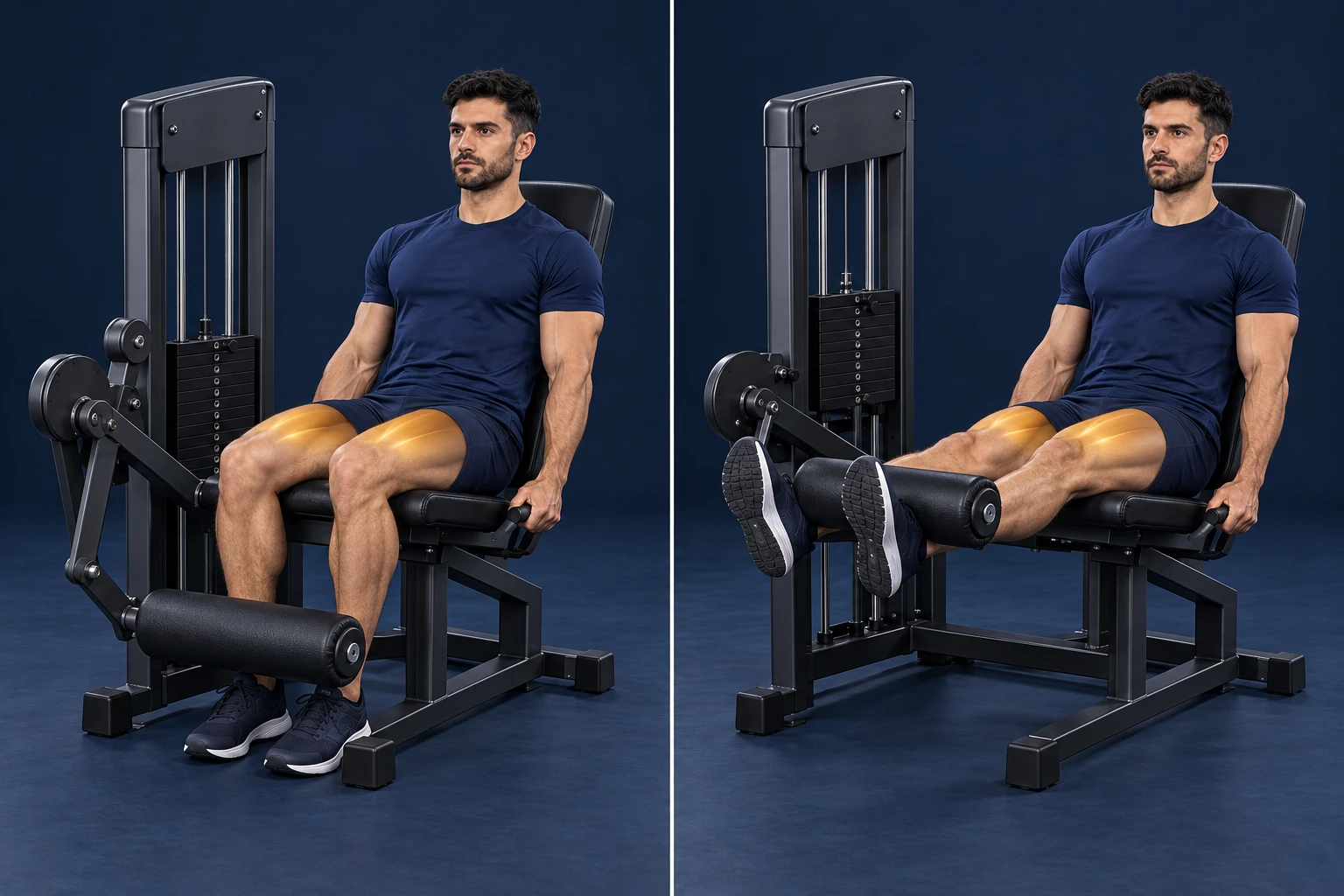
Execution sequence
- Identify the first single-joint exercise and the following compound exercise.
- Perform the first exercise to the assigned effort limit; absolute failure is not automatic.
- After the prescribed transition or rest, perform the second exercise with a load appropriate to these conditions.
Reading a program example
The source example is a machine leg extension followed by a barbell back squat. A squat load used without prior fatigue is not automatically suitable for this sequence.
Important distinction
The sequence does not guarantee greater activation or growth. Research findings differ, and fatigue from the first exercise can change performance in the second. Session goals and individual ability remain central.
Check before starting
- Do not copy the second exercise’s usual load without accounting for prior fatigue.
- Check rack safety settings and any required assistance for free-weight exercises.
- Do not reverse the order without checking; that changes the system.
Frequently asked questions
Is pre-exhaustion just a warm-up?
No. The first exercise is a working component that can create fatigue. Warm-up and preparation are separate.
Must the second exercise use my usual straight-set load?
No. The load should be assigned for this sequence and effort limit rather than changed arbitrarily.